
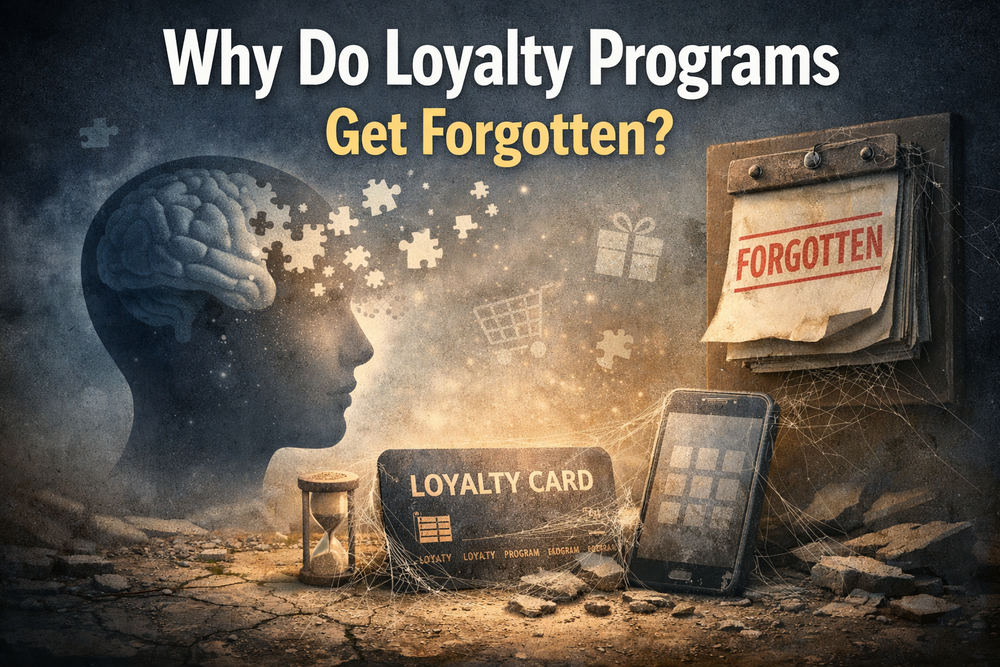
A customer joins a loyalty program.
They get the card.
They download the app.
They might even use it once.
And then something happens:
👉 the program disappears
Not physically — but mentally.
And that’s the most critical, yet least discussed problem in loyalty systems:
👉 being forgotten
Being Forgotten Means Not Existing
If a loyalty program is not actively present in a customer’s life, its existence doesn’t matter.
If customers:
- don’t remember the card
- don’t open the app
- don’t think about the program
👉 the program doesn’t exist
Loyalty programs don’t fail first.
They are forgotten first.
Human Behavior: If You Don’t Remember It, You Don’t Use It
The human brain follows a very simple rule:
👉 what is not remembered is not used
Customers don’t make a conscious effort to remember your loyalty program.
Because:
- they have more important things to think about
- they don’t want to make extra decisions
- they avoid mental effort
If your system doesn’t remind itself:
👉 it will be forgotten
1. Loyalty Programs Are Not Part of Daily Life
Most loyalty systems live outside of the customer’s natural flow.
- separate apps
- separate cards
- separate systems
Customers only interact with them when they remember.
And the problem is:
👉 they rarely do
Because the system is not integrated into everyday behavior.
2. No Visibility Means No Behavior
One of the biggest weaknesses of loyalty programs is lack of visibility.
The more often customers see something, the more likely they are to use it.
But most programs:
- only appear during campaigns
- are not visible in daily life
- don’t create ongoing interaction
And as a result:
👉 no habit is formed
3. The Burden of Remembering Is on the Customer
Many loyalty systems expect customers to:
- carry the card
- track their points
- remember to use the program
This is a fundamental mistake.
Because customers:
👉 don’t want to remember
Modern users outsource memory to systems.
If your system depends on the user remembering it:
👉 it’s already broken
4. Loyalty Programs Are Used Occasionally, Not Habitually
Most loyalty programs are not designed for frequent use.
Customers:
- use them occasionally
- try to remember them when needed
- often realize they’ve forgotten
This prevents habit formation.
But real loyalty is:
👉 a habit
5. The System Doesn’t Remind Itself
Successful systems don’t rely on users.
They remind themselves.
But most loyalty programs:
- are passive
- wait for user action
- don’t proactively engage
Which leads to one outcome:
👉 invisibility
And invisible systems get forgotten.
6. Competition for Attention Is Brutal
Today, customers are constantly exposed to:
- dozens of brands
- hundreds of messages
- endless notifications
In this environment, attention is limited.
If your system:
- doesn’t have a strong touchpoint
- doesn’t live where customers already are
👉 it will be ignored
The Core Issue: No Space in Memory
The real problem is not engagement.
👉 it’s memory
Most loyalty programs:
- don’t create enough value
- don’t stay visible
- don’t integrate into daily life
So the brain categorizes them as:
👉 unimportant
And what’s unimportant gets deleted.
So How Do You Build a System That Isn’t Forgotten?
Systems that are remembered share one trait:
👉 they are always present
A successful loyalty system:
- lives where the customer already is
- becomes part of natural behavior
- requires no extra effort
And most importantly:
👉 it reminds itself
Final Thought
The biggest problem with loyalty programs isn’t failure.
👉 it’s being forgotten
Because once something is forgotten:
- it’s not used
- it doesn’t change behavior
- it creates no value
Maybe it’s time to stop asking:
“How do we give better rewards?”
And start asking:
👉 “How do we stay present in the customer’s life?”
What Do You Think? Why do you think loyalty programs get forgotten? What’s the real reason?