
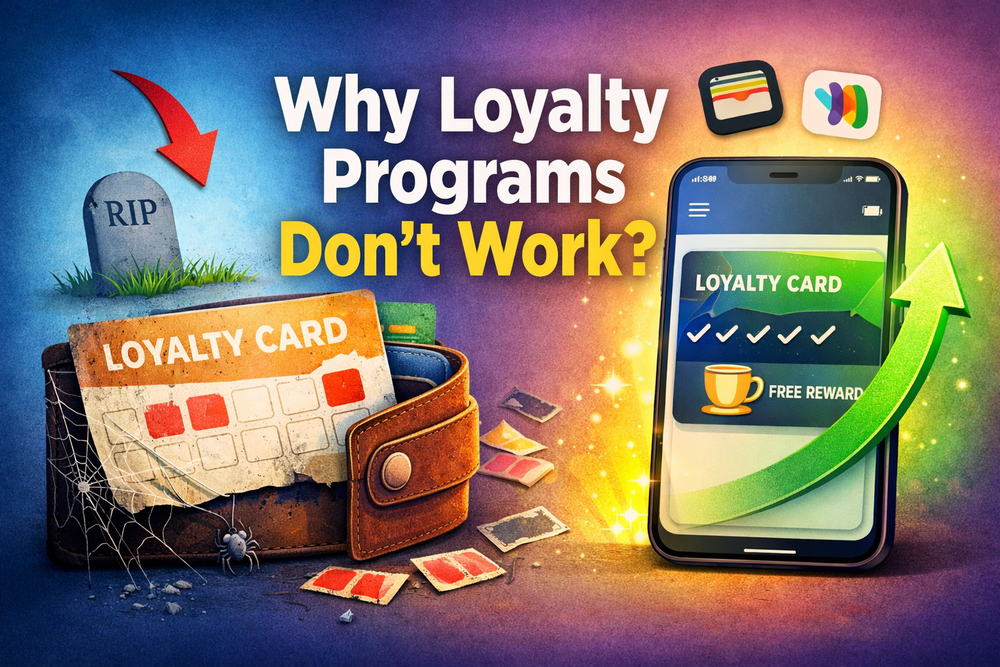
Think about your wallet for a moment. It probably holds a few credit cards, an ID card, and maybe one or two loyalty cards. But answer this honestly: when was the last time you actively used a loyalty card?
For most people, the answer is simple. They either do not remember, or it was a very long time ago.
The problem is not loyalty programs themselves. The problem is that most of them are designed in a way that goes completely against human behavior. And that is why most of them die before they even really begin.
Why Loyalty Programs Actually Fail: They Are Forgotten
When many businesses create a loyalty program, they focus on questions like these:
- How many points should we give?
- After how many purchases should we offer a reward?
- What kind of campaign should we run?
But the real problem is usually overlooked: does the customer even remember the program exists?
- Physical cards get lost.
- Apps are downloaded, but never used.
- Sign-up flows feel tiring.
And in the end, the customer forgets the program entirely.
That is why most loyalty programs fail. This is not really a rewards problem. It is an access problem.
The “Download the App” Era Is Over
Traditional digital loyalty tools did not solve this issue. In many cases, they made it worse. Because they added another layer of friction:
- Download the app
- Sign up
- Create a password
- Allow notifications
And then what happens? The app is never opened again.
Today, people already have dozens of apps on their phones. Making room for one more is much harder than most businesses think. That is why many loyalty programs lose the customer at the very first step.
A New Approach: Bring Loyalty to Where the Customer Already Is
This is the key shift: Instead of trying to bring the customer into the loyalty program, bring the loyalty program to where the customer already is.
And today, there is one place that is already built into their phone: their digital wallet.
- Apple Wallet
- Google Wallet
People already use it to store boarding passes, payment cards, and event tickets. Most importantly, it is already there. No download required.
That is exactly why this is the right place for loyalty to live.
What Is Wallet-Native Loyalty?
Wallet-native loyalty means designing the loyalty experience not as another app, but as something that lives directly inside the customer’s wallet.
In this model:
- The customer does not download an app
- The sign-up process is minimal
- The card is added directly to the wallet
- Notifications arrive naturally
And the most important difference is this: the loyalty program is no longer forgotten.
Because the customer carries it in a place they already see and use every day.
Simple Real-Life Scenarios
You do not need complex examples to understand the impact of this approach.
Imagine you run a coffee shop. A customer comes to the counter, scans a QR code, and adds the card to their wallet. With every purchase, they automatically earn a stamp.
At the ninth stamp, a notification appears on their phone: “One coffee left.”
That is it. No physical card, no app, no friction.
Or imagine a gym. The membership card lives in the customer’s wallet. They scan it at the entrance and walk in. Before it expires, they receive a reminder.
Simple. Smooth. Unforgettable.
Loyalty Is Actually a System Design Problem
Loyalty is often misunderstood. It is not just a campaign issue. It is not just about saying, “Let’s give 10% off.”
It is a system design problem.
- If the system is not easy to access,
- if it does not stay visible,
- if it is frustrating to use,
then no reward structure will save it.
But when the system is designed correctly:
- customers return more often,
- they spend more,
- and they build a stronger connection with the brand.
How We See This Problem
For the past few months, we have been looking at this problem very closely. Across different industries, we kept seeing the same thing:
Loyalty programs are not failing because people do not want them. They are failing because they are living in the wrong place.
That is why we started rethinking loyalty from the ground up.
- Without forcing people to download another app.
- Without asking them to carry another card.
- Without making the experience harder than it needs to be.
We started asking a simple question:
Can loyalty become something that fits naturally into everyday life?
What Happens Next?
The future of loyalty will be built on:
- less friction,
- fewer apps,
- and better integration.
And most likely, within the next few years, physical loyalty cards will disappear entirely. App-based loyalty solutions will become far less relevant.
In their place, we will see systems that are almost invisible, but always working in the background.
What do you think? Do loyalty programs really not work, or have we simply been building them the wrong way?