
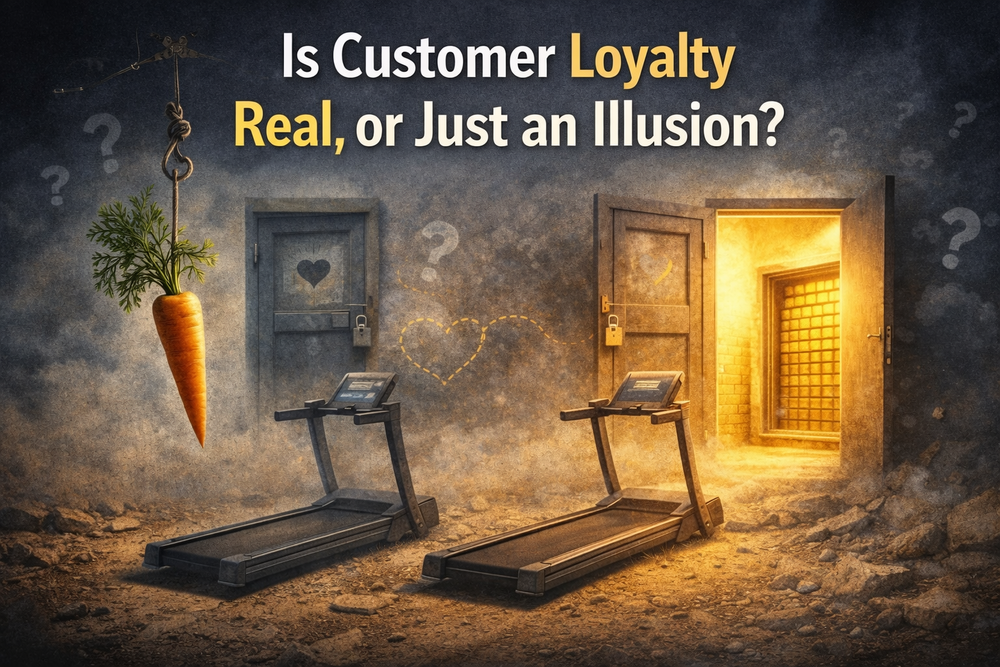
“Customer loyalty” is one of the most widely used concepts in business.
It appears in strategy decks, marketing plans, and almost every discussion about growth. Yet despite how often it’s mentioned, it’s rarely examined deeply.
Why does a customer come back?
The most common answer is simple: because they’re loyal. But in many cases, this explanation only scratches the surface. A returning customer is not necessarily a loyal one — they are simply returning.
At first glance, this distinction may seem minor. In reality, it changes everything. A customer might choose you repeatedly, but that choice is often driven by conditions rather than commitment. Convenience, price, or lack of better alternatives can all explain the behavior.
The Gap Between Loyalty and Behavior
Customer loyalty is typically described as an emotional bond. Trust in the brand, habit, and a tendency to return are all part of this definition. However, real-world customer behavior is rarely that ideal.
Most customers don’t make conscious decisions to be loyal. Instead, their choices are pragmatic. They choose what is fastest, easiest, and least risky.
What appears to be loyalty is often just the result of optimization.
This is where the misunderstanding begins. Businesses observe behavior and assume there is an underlying emotional connection. In reality, there often isn’t — there are simply favorable conditions.
How Loyalty Programs Reinforce the Misconception
Many loyalty programs are built on this flawed assumption. If customers are rewarded, they will become loyal. But this approach treats loyalty as something that can be directly created.
In reality, loyalty is not a tool — it is an outcome.
When a system is well designed, customers feel comfortable within it. They return, not because they are trying to be loyal, but because the experience makes sense. Over time, this repeated behavior turns into habit. From the outside, it looks like loyalty.
This is why many loyalty programs fail. They try to manufacture loyalty, instead of designing the conditions that allow it to emerge.
Why Loyalty Is Often Overestimated
The idea of loyalty has been romanticized in marketing for years. Brands like to believe that customers choose them intentionally and remain committed over time. It creates a sense of control and predictability.
But modern consumer behavior doesn’t support this narrative.
Today’s customers:
- have more options than ever
- make decisions faster
- show less long-term commitment
In this environment, loyalty is not a fixed state. It is fluid. A customer may choose you today and switch tomorrow — not because they lost trust, but because a better option appeared.
Loyalty Is Not a Cause — It’s a Result
The most important shift in perspective is this:
Loyalty is not what brings customers back.
It is what appears after they come back.
If a system is:
- easy to use
- consistently visible
- delivering value
customers return naturally.
Repeated behavior becomes habit.
And habit is what we label as loyalty.
But that loyalty only exists as long as the system continues to work.
The Most Common Mistake Businesses Make
Many businesses treat loyalty as a goal. They try to retain customers, build emotional connection, and increase brand attachment directly.
But loyalty cannot be forced.
It is a natural outcome that only appears under the right conditions.
Instead of trying to create loyalty, businesses should focus on designing systems that make returning effortless. Systems that don’t require thinking, remembering, or extra effort.
A More Accurate Way to Think About Loyalty
A more useful way to understand customer loyalty is to see it not as an emotion, but as a behavioral pattern.
Why does a customer come back?
The answer is rarely “because they are loyal.”
It is usually “because it’s easy.”
When ease, visibility, and consistency align, customers return. Over time, that behavior stabilizes.
And we call it loyalty.
Are customers truly loyal to brands, or are they simply choosing what is most convenient in the moment, and could what we call loyalty actually be nothing more than a habit shaped by the system itself?